
How does data support good governance?
By Lindsey MacDonald, Deputy Chair at DataKind UK and Chief Executive at Magic Breakfast

When times are challenging, and difficult decisions need to be made, asking the right questions and having the data to answer them can be crucial.
On the back of Trustees’ Week and an updated Charity Governance Code, we’re looking at how governance can be empowered by data, and vice versa.
Despite a huge interest in data, the third sector faces a huge number of challenges in using data more effectively. The headlines are that it’s not easy, and it’s not cheap. The majority of charitable organisations have incomes under £100,000, and the cost-of-living crisis has put enormous strain on all of us. Recent news from the sector has covered non-profit closures, staff redundancies, fierce competition for funding, and increased demand for services.
When times are challenging, and difficult decisions need to be made, asking the right questions and having the data to answer them can be crucial. How can you frame organisational issues, and assess whether data can help you solve them?
What does good governance look like?
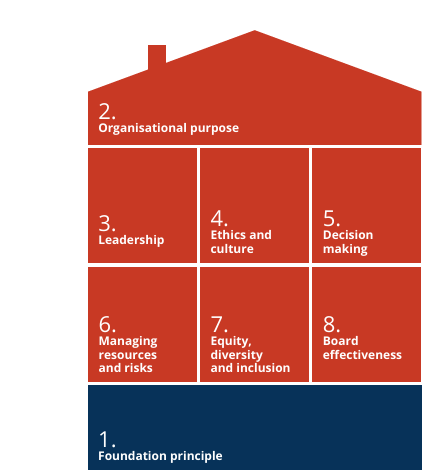
The Charity Governance Code, updated in October 2025, sets out effective governance for charities in the UK. It has an ‘apply or explain’ principle, which means you either apply it or explain why you don’t. This might be because there is another, more specific code that applies to your organisation, such as housing associations.
The code emphasises the importance of understanding the foundations of good trusteeship. Its eight key principles provide 41 outcomes for good governance, with extra detail about the behaviours and practices needed to uphold this. Many of these principles rely on good policies and processes to be realised, and will help to make data a valuable asset for your organisation.
The Code’s eight principles are illustrated as building blocks that form a house: 1) Foundation principle; 2) Organisational purpose; 3) Leadership; 4) Ethics and culture; 5) Decision making; 6) Managing resources and risks; 7) Equity, Diversity and Inclusion; and 8) Board effectiveness.
Combining governance and data analysis
Policy, processes, and practices will provide the foundations for safe, effective, compliant data collection and use, whether it's your GDPR policy or AI guidance. Many of the behaviours the code recommends are also what help make data valuable, such as curiosity, openness, and being willing to say when you don’t understand something.
The code describes what it looks like when certain aspects of your organisation are working well, sets out more specific outcomes that ensure progress, and suggests evidence and assurance to use along the way.
The next examples illustrate principle five, ‘Decision making’, and principle seven, ‘Equity, Diversity, and Inclusion’, although they could sit across multiple principles.
Smark Works and Decision making

Smart Works exists to inspire and empower women who need help getting into work. From its 11 centres across the UK, it provides interview and career coaching, alongside high-quality workwear, to help women enter the workplace.
With over 632,500 unemployed women in the areas where they operate, Smart Works knew they were not reaching all of the women who could benefit from their support. They faced a huge challenge in identifying where there were gaps in their provision.
We needed to turn a broad problem - ‘We can’t find all of our potential beneficiaries’ - into a specific one that has clear actions for Smart Works: “We want to know where eligible beneficiaries are missing out on our services. If we find out their locations, we can work with relevant Local Authorities to plan outreach to these women in order to offer them our support.”
The Code sets out what it looks like when ‘decision making’ is working well. It’s working when ‘The board has the information and analysis needed to make timely and well-informed decisions.’ This is a key reason why Smart Works’ project was so vital. It provided clear evidence and benchmarking about their existing beneficiaries.
It also guided them to the steps the organisation could take to reach a key audience of theirs, and justified the need to increase support and expand networks in specific regions.
Magic Breakfast and Equity, Diversity, and Inclusion (EDI)
Magic Breakfast’s mission statement is that no child or young person should be too hungry to learn. They offer stigma- and barrier-free breakfasts to more than 300,000 pupils daily. So they want to be clear who’s not getting breakfast and what barriers, real and perceived, are facing children, young people, and their families.
When analysing Magic Breakfast’s data, a lot of insight came from the different characteristics of pupils and schools. For example, two groups that showed particularly low uptake of their services were those with English as second language, and pupils from Bangladeshi community.
It's important that next steps are grounded in the charity’s context and enable delivery of its aims. The code sets out that EDI is working when: ‘The board sets clear EDI aims and ensures progress through dedicated plans, resources, and monitoring.’ For trustees, the evidence that you’d use when applying the code is in your board papers, which should identify key data and risks. These should act as a baseline, the starting point from which to choose where you want to make changes.
The board should also make sure that these successes and challenges get shared publicly, as much as possible. This reflects the fact that these principles complement and reinforce each other. Openness and accountability is closely linked to EDI, so this is another piece of evidence towards good practice in line with the code.
Getting started
How can we think about collecting and using data, and framing data ‘problems’, in a collaborative way?
When we are asked about how any third sector organisations can use data more effectively, we always start with the problem or challenge organisations or individuals are facing or trying to solve. This will increase the chance that any use cases really add value and direct trustees to the data they should focus on.
Usually, the hardest part of the problem is figuring out what you want to know. At a recent workshop with trustees and senior charity leaders on this topic, the theme that emerged in the room was that they felt they had too much data. They weren’t always clear what was important, and what to use to inform decisions.
Testing assumptions and finding gaps
It can be helpful to think about the things you think you know, or hunches your team has, and then look at whether these can be tested with data. What do the people delivering your services on the ground think? Often, there are assumptions your team is making that can be proven correct - or false!
You can ask them directly what the hardest part of their job is, or what they wish they felt more certainty about. Talk to them about the major pain points in their daily work, and zoom out to ask what gaps are getting in the way of achieving your organisation’s mission. What evidence will help you make important, mission-driven decisions?
Taking action
When you’re looking at your problem, you should also think about what you would do once you have found some answers. It should be specific enough to tell you who will act, when, and how. It’s also helpful to think about guidelines and policies, such as no-go areas for you and your organisation. What other values does your organisation hold and how do these inform your approach to data collection and use?
Finally, if you get answers, they must be grounded in the organisation’s mission. Is the solution that the data indicates actually within your control, and aligned with your Theory of Change or current approach to tackling the problem you want to solve?
Problem-framing exercise
Our org’s problem is that… [specific problem statement]
If we could see / if we knew… [information we are missing]
Using the data… [what data do you have / need]
We could… [action we might want to take]
Which would… [impact for our organisation/mission]
What now?
One of the best ways to introduce data-guided thinking into your team is to recruit a trustee who already has these skills. There are many data professionals out there looking to donate their time and expertise. So, when you next look for a new board member, ensure you highlight responsible data use as an important part of your governance strategy.
